We must stand in unity. When one person’s voice is silenced, it is up to the rest of us to cry out. Justice is not a flexible tool. It must be applied to all and it must be applied equally. This is a shared planet, and until we can learn to respect and tolerate one another’s differences, we risk the continued loss of our freedom, our dignity, and the chance to create a peaceful world for our children.
~Leonard Peltier, In the Spirit of Crazy Horse
As I walked from the bus stop to the front of the march, I could feel my chest tighten as it does when I get emotionally overwhelmed. The signs I saw and the chants I heard had such big messages for being so concise. "Obama, Escucha, estamos en la lucha!" (Obama, listen, we are in the fight!) was chanted throughout the march.
"Which one is the illegal one?" with three shoes drawn (photo below) struck me as Arizona considers arresting people who "look" illegal.
"My husband supports us. If he's deported, America will." (photo below) made realize how silly our arguments can be for splitting up families just to make our point.
I always learn about people when I attend events like this. Listening to their voices instead of my own arguments for or against seems to have so much more rationale and reasoning than I can come up with. It's important to listen to the people who are affected by these laws. Maybe by listening to them, we might understand how we can do a better job of helping out the country they left as well as helping them in the country they immigrated to.
Showing posts with label Hispanic. Show all posts
Showing posts with label Hispanic. Show all posts
Sunday, May 02, 2010


Sunday, March 28, 2010
Maggie's Cleaning Service
I went to dinner with one of the college students last night. Now that she's in college, we go to dinner every once in a while to talk and catch up. As she has continued in college, she has found that, unfortunately, most of her friends from high school did not. Though she keeps up with some of them, most have babies now and she doesn't feel like she has a lot of similar interests. I am so impressed with her determination to persevere on her own. She often feels like the lone rider on her trek to graduate from college.
I am in awe of her hard work. Not only does she commute an hour back and forth to Denton each day to attend school at UNT, she also works with her mom cleaning houses and mentoring her brothers and sister. She's the oldest. She wants to ensure her siblings move in the right direction as well so despite her exhaustion, she makes sure to help them with homework, talk to them about college, and help the oldest brother try to figure out what he wants to be and encourage him to find a direction after high school.
When we get together, she often tells me about working for people who have so much money that they don't have to think about if they can afford something. She never speaks with any condescension. As she tells me, it's always with surprise that people can afford stuff at a whim and with no thought about the cost.
Last night as she was talking, she said one day she wanted to hire "Maggie's Cleaning Services" to clean her house. Since I knew she and her mother clean houses, I thought maybe her mom worked for someone else and that was the name of the company. She laughed and said, "No, I joke with my mom and call her Maggie because the people she works for call her that. I guess they think 'Margarita' is too long of a name to say."
We laughed about the ridiculousness of that. Quite honestly, I was rather irritated and appalled. Who gave anyone the right to change or shorten her given name? Why do people think they can do that? Does Margarita sound too Latino for them? I'm guessing 'Maggie' sounds more like a name in their community so they just decide to call her that. How insulting!
I always remember my mom telling me, "I named you Janet. If I would've wanted you to be named Jan or Janice, I would've named you that." I don't like when people change my name for me. I understand an unintentional mistake, but I will correct them if they call me something other than my name.
I'm going to try not to speculate and make comments about why I believe people have shortened Margarita to a more childish sounding name like Maggie. Instead, I'm going to hope they are reading this and have an a-ha moment of how degrading and insulting that is. I hope they will apologize to Margarita and any other people they might have disrespected in that way and make it a point from this day forward to take the time to learn and pronounce each person's given name no matter how different it sounds to them.
Names are important. We were each given a name and unless we decide to change that name, it isn't anyone else's right to change it for us.
I am in awe of her hard work. Not only does she commute an hour back and forth to Denton each day to attend school at UNT, she also works with her mom cleaning houses and mentoring her brothers and sister. She's the oldest. She wants to ensure her siblings move in the right direction as well so despite her exhaustion, she makes sure to help them with homework, talk to them about college, and help the oldest brother try to figure out what he wants to be and encourage him to find a direction after high school.
When we get together, she often tells me about working for people who have so much money that they don't have to think about if they can afford something. She never speaks with any condescension. As she tells me, it's always with surprise that people can afford stuff at a whim and with no thought about the cost.
Last night as she was talking, she said one day she wanted to hire "Maggie's Cleaning Services" to clean her house. Since I knew she and her mother clean houses, I thought maybe her mom worked for someone else and that was the name of the company. She laughed and said, "No, I joke with my mom and call her Maggie because the people she works for call her that. I guess they think 'Margarita' is too long of a name to say."
We laughed about the ridiculousness of that. Quite honestly, I was rather irritated and appalled. Who gave anyone the right to change or shorten her given name? Why do people think they can do that? Does Margarita sound too Latino for them? I'm guessing 'Maggie' sounds more like a name in their community so they just decide to call her that. How insulting!
I always remember my mom telling me, "I named you Janet. If I would've wanted you to be named Jan or Janice, I would've named you that." I don't like when people change my name for me. I understand an unintentional mistake, but I will correct them if they call me something other than my name.
I'm going to try not to speculate and make comments about why I believe people have shortened Margarita to a more childish sounding name like Maggie. Instead, I'm going to hope they are reading this and have an a-ha moment of how degrading and insulting that is. I hope they will apologize to Margarita and any other people they might have disrespected in that way and make it a point from this day forward to take the time to learn and pronounce each person's given name no matter how different it sounds to them.
Names are important. We were each given a name and unless we decide to change that name, it isn't anyone else's right to change it for us.
Saturday, July 11, 2009
Including ALL of our history
Some things are just hard to believe.
I received a tweet from EIFdotorg the other day saying, "TX Conservatives seek to remove a woman, a Hispanic, and a Black man from Social Studies curriculum," and then referenced this article: Conservatives seek to shift focus of state social studies lessons.
Surely, they were exaggerating.
But, sure enough, here are some quotes from the article:
How can we continue to say that Black people, Hispanic people, and women have made no real contribution to our society? How can we claim that someone like Ben Franklin deserves to be in a history book, but César Chávez does not?
The arguments I've heard is that including diversity in the curriculum requires that we take out all of the "important people" in order to have enough room to include others (i.e. women and people of other ethnicities). Who originally determined who those "important people" are? Where is the rating scale and what do we look for to determine that? How does someone like Peter Marshall get to be the authority figure on what is and isn't important?
I'm not suggesting that Ben Franklin is any less important than César Chávez. There have been a lot of contributions to our society over the years. We wouldn't be in the position we are without all of those contributions. The light bulb, electricity, and the first president of the United States were important contributions. But so was the filament that goes in the light bulb, the stop light, windshield wipers, COBOL (a common computer language), Kevlar (the material that makes bullet proof vests bullet proof) , color television, and so many more--contributions made by women and people of color.
Including women and people of color in the text books aren't about excluding white men. It's about including the contributions of every sector of our society.
I received a tweet from EIFdotorg the other day saying, "TX Conservatives seek to remove a woman, a Hispanic, and a Black man from Social Studies curriculum," and then referenced this article: Conservatives seek to shift focus of state social studies lessons.
Surely, they were exaggerating.
But, sure enough, here are some quotes from the article:
"To have César Chávez listed next to Ben Franklin" – as in the current standards – "is ludicrous," wrote evangelical minister Peter Marshall, one of six experts advising the state as it develops new curriculum standards for social studies classes and textbooks.
Marshall also questioned whether Thurgood Marshall, who argued the landmark case that resulted in school desegregation and was the first black U.S. Supreme Court justice, should be presented to Texas students as an important historical figure. He wrote that the late justice is "not a strong enough example" of such a figure.
Both Barton and Marshall also singled out as overrated Anne Hutchinson, a New England pioneer and early advocate of women's rights and religious freedom, who was tried and banished from her Puritan colony in Massachusetts because of her nontraditional views. "Anne Hutchinson does not belong in the company of these eminent gentlemen," he said, referring to colonial leaders William Penn, Roger Williams and others.
How can we continue to say that Black people, Hispanic people, and women have made no real contribution to our society? How can we claim that someone like Ben Franklin deserves to be in a history book, but César Chávez does not?
The arguments I've heard is that including diversity in the curriculum requires that we take out all of the "important people" in order to have enough room to include others (i.e. women and people of other ethnicities). Who originally determined who those "important people" are? Where is the rating scale and what do we look for to determine that? How does someone like Peter Marshall get to be the authority figure on what is and isn't important?
I'm not suggesting that Ben Franklin is any less important than César Chávez. There have been a lot of contributions to our society over the years. We wouldn't be in the position we are without all of those contributions. The light bulb, electricity, and the first president of the United States were important contributions. But so was the filament that goes in the light bulb, the stop light, windshield wipers, COBOL (a common computer language), Kevlar (the material that makes bullet proof vests bullet proof) , color television, and so many more--contributions made by women and people of color.
Including women and people of color in the text books aren't about excluding white men. It's about including the contributions of every sector of our society.
Sunday, August 20, 2006
Quinceñera
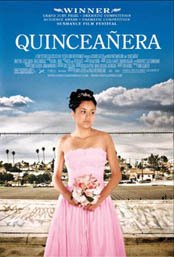 I watched a great movie last night. Quinceañera presents several different issues--from gay culture to Latino culture to gentrification. The movie does a good job of presenting how gentrification affects the people (most often people who have little financial means and are people of color) who live in the communities that are being gentrified. I would highly recommend it. Below is a summary and a link. Check it out:
Quinceañera remarkably won both the Grand Jury Prize and the Audience Award at this year’s Sundance Film Festival, and is directed by breakout filmmakers Richard Glatzer and Wash Westmoreland. This profoundly moving drama depicts the uniqueness of Latino culture and follows Magdalena (Emily Rios), a fifteen year old girl getting ready for her big Quinceañera celebration. But when an unexpected pregnancy leads her to be banished from her parents’ home, she moves in with her grand-uncle and troubled cousin and becomes part of a makeshift family that must stand up to social stigmas and encroaching urban gentrification that threatens their neighborhood and their culture.
Click here to go to the Quinceñera website.
Click here to listen to Latino USA's report on the movie.
Thursday, May 04, 2006
Thank you

My friend, Olga Rodriguez, sent me this link. Although I know there are many disagreements about what should be done about immigration, I would think we could at least agree to acknowledge the way immigrants have contributed to our society. No matter what we believe, I think it's important to stop and take notice of what they have done for our society and for us individually.
NPR : Thanking Immigrants for the Myriad Jobs They Do
<http://www.npr.org/templates/story/story.php?storyId=5325714>
Sunday, April 23, 2006
Moving beyond the "System"
I've had many different friends get frustrated with me because of my pessimism with the "system.""...just as we must avoid a superficial optimism, we must also avoid a crippling pessimism."
~Martin Luther King, Jr.
I think the system is wrong.
I think the education system in our country benefits some kids, but not all. I think that the lack of motivation and lack of hope in many of our communities stem from the problems that our "system" has created over many years. I think that racism is institutional. And I often talk about my views with [African-American and Hispanic] teenagers and adults.
I have had people tell me that I perpetuate the separation of the cultures by having those types of discussions. I have had other people tell me that what I say gives people an excuse to place all of the blame on the system and not take responsibility for their own actions. In my mind, I talk about things like racism, poverty, and injustice because it is liberating. Growing up, I wasn't aware that so much injustice and discrimination existed (past tense) and still exists (present tense). No one acknowledged it. It made me angry when I finally learned and internalized the Civil Rights movement and began learning from friends and neighbors that discriminatory practices and actions still happen all the time.
When I have taught groups of kids, teenagers, and adults, I do admit that I acknowledge the painful past and deal with the frustrating present. I find that people become more animated, opinionated, and reflective when I start talking about the inequity in our urban community, the racism in our society and the inadequacy of our schools--particularly if they have personally dealt with any of those issues. I feel like I'm pointing out the huge elephant in the middle of the room that no one talks about...at least not in mixed company. I feel like I'm the one telling people the emporer has no clothes. It seems to be implied that if we don't talk about racism, poverty, and injustice, it won't exist. Yet, I've found that whether I talk about it or not, the people who experience the discrimination and the injustice still know it's there. It doesn't go away. Ignoring it just makes it invisible to me...a white person who isn't usually discriminated against and has many monetary privileges and choices anyway.
But, at the same time, I am trying to think through what some of my friends who disagree with me say. I don't want to end on the note that the system's screwed up, as much as I believe that. I want to go beyond that...like Martin Luther King, Jr. did. I want to communicate to friends and neighbors...in the suburbs and rural areas as much as in the cities...that we do have a voice! And we need to speak out against injustice! We need to vote against unjust practices. We need to stand by someone who has been discriminated against--be it race, homosexuality, disability, or gender. We need to get together. We need to stop allowing the system to cripple us.
Yes, injustice is frustrating. Yes, people have been beat down for a long time (sometimes literally) and may not trust the police, the voting process, the government officials, etc. I agree. I have become leery of many of the practices myself. We have many things working against us. However, in order to change things, we must make our voice heard and we must fight...peacefully.
As King said, "...we must avoid a superficial optimism." We haven't arrived yet. We've got to get over trying to ignore racism and injustice and pretend that it will just go away. It won't. It won't until we deal with it. But at the same time, "...we must also avoid a crippling pessimism." Despite how tired and frustrated we are, we've got to keep pressing on and moving ahead.
Most recently, the Hispanic community has taken the lead in this. I would advocate that we all fall in and begin working together. It shouldn't just be a Brown issue. It's everyone's issue. After we conquer that injustice, we can move on to other injustices....together.
Subscribe to:
Posts (Atom)